How to Teach Children Basic Money Skills
Teaching children basic money skills is one of the best ways to help them develop responsible financial habits early in life. Children may not understand salaries, bills, loans, or bank accounts fully, but they can learn simple lessons about saving, spending, sharing, choices, and patience.
Money lessons do not have to be complicated. They can begin at home through normal daily activities such as shopping, giving pocket money, saving coins, comparing prices, planning for school items, or discussing why some things must wait.
The Consumer Financial Protection Bureau explains that children and young people can develop the building blocks of financial capability at home, school, and in the community. Its youth financial education tools are designed to help teach financial literacy even to people who are new to the topic.
The goal is not to make children worry about money. The goal is to help them understand that money is earned, planned, saved, and spent carefully.
Why Children Should Learn About Money
Children grow up watching how adults use money. They notice shopping, mobile money payments, school fees, bills, saving, borrowing, and family spending. Even when adults do not explain money directly, children still learn from what they see.
Teaching children about money helps them understand:
- Money does not appear automatically
- People work to earn money
- Spending requires choices
- Saving helps prepare for future needs
- Wants and needs are different
- Borrowing should be handled carefully
- Not everything can be bought immediately
Canada’s Financial Consumer Agency says teaching children how to manage money can help them throughout life, and that starting early allows parents to build on their knowledge as they grow.
Start with Simple Money Conversations
The first step is to talk about money in a simple and age-appropriate way.
You can explain that money is used to buy things people need and want. You can also explain that adults earn money through work, business, farming, services, or other activities.
For example, when buying groceries, you can say:
We have money for food today, so we choose the most important items first.or:
This item is nice, but it is not in our budget today.These small conversations help children understand that money decisions are normal and should be thought through.
Teach That Money Is Earned
Children should learn that money usually comes from work, effort, skill, business, or service.
You can explain this using examples they understand:
- A teacher earns money by teaching.
- A shop owner earns money by selling goods.
- A farmer earns money by growing and selling crops.
- A driver earns money by transporting people.
- A parent may earn money through employment or business.
This helps children respect money because they understand that it takes effort to earn it.
You can also give small age-appropriate responsibilities at home, but be careful not to make every family duty about payment. Some tasks are part of helping the family, while extra tasks may be linked to a small reward.
Teach Saving with a Jar or Box
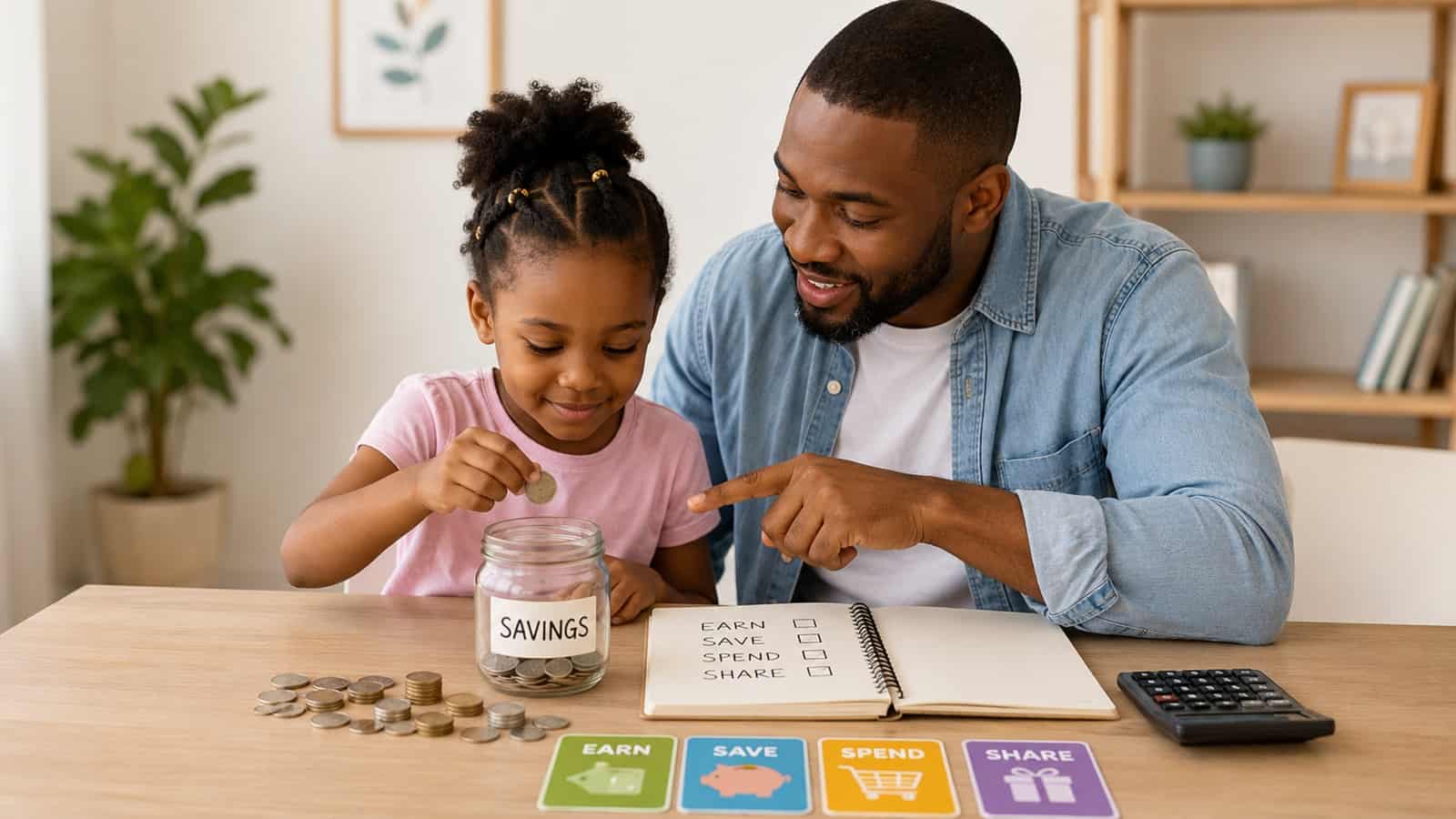
A savings jar is one of the simplest ways to teach children about saving.
Give the child a jar, box, envelope, or small wallet where they can keep coins or small amounts of money. Let them see the money growing over time.
This makes saving visible and exciting.
You can label the jar:
My Savingsor:
New Book Fundor:
School Trip SavingsA clear label helps the child connect saving with a goal.
FDIC’s Money Smart for Young People provides age-appropriate financial education materials for pre-kindergarten through Grade 12, showing that children can learn money concepts in stages as they grow.
Teach the Difference Between Needs and Wants
One of the most important money lessons for children is the difference between needs and wants.
A need is something important for daily life, health, school, or safety.
Examples of needs:
- Food
- School uniform
- Basic clothing
- School books
- Medicine
- Transport to school
- Safe housing
A want is something nice to have, but not necessary.
Examples of wants:
- Sweets
- Toys
- Extra snacks
- Expensive shoes
- Video games
- Fancy clothes
- Entertainment items
You can teach this during shopping.
For example:
Bread is a need because we need food. Sweets are a want because we can live without them.This helps children learn that needs should come before wants.
Use Pocket Money Carefully
Pocket money can be a useful teaching tool when used well.
It teaches children how to make choices. If they spend everything quickly, they learn that money can finish. If they save part of it, they learn patience and planning.
The amount does not need to be large. What matters is the lesson.
You can teach a simple rule such as:
Spend some, save some, and share some.For example, if a child receives KSh 100, they can divide it like this:
| Use | Amount |
|---|---|
| Save | KSh 40 |
| Spend | KSh 40 |
| Share or give | KSh 20 |
The exact amounts can change depending on the family situation.
Teach Budgeting in a Simple Way
Children can learn basic budgeting without complex calculations.
A budget simply means planning how money will be used. Consumer.gov explains that a budget is used by planning spending at the beginning of the month, tracking spending each day, and reviewing whether spending matched the plan at the end of the month.
For children, you can simplify budgeting like this:
How much money do you have?
What do you want to buy?
How much will you save?
Will the money be enough?
Example:
| Item | Amount |
|---|---|
| Pocket money | KSh 200 |
| Save | KSh 80 |
| Buy snack | KSh 50 |
| Keep for later | KSh 70 |
This teaches planning before spending.
Teach Children to Set Small Goals
Saving becomes easier when a child has a goal.
Instead of saying:
Save your money.Say:
Let us save KSh 500 for the book you want.or:
You need KSh 300 for that toy. Let us plan how you can save for it.Small goals help children understand patience.
Examples of child-friendly saving goals:
- A storybook
- A toy
- A school trip
- Art materials
- A sports item
- A birthday gift
- A savings target
When they finally reach the goal, they learn that saving works.
Teach Delayed Gratification
Delayed gratification means waiting for something instead of buying it immediately.
This is a powerful money lesson.
Children often want things immediately, especially sweets, toys, snacks, or entertainment. Instead of saying yes or no without explanation, use the moment to teach.
You can say:
We cannot buy this today, but we can save for it.or:
You can buy this small item now, or save for the bigger item later.This teaches children that money decisions involve trade-offs.
Let Children Make Small Money Decisions
Children learn better when they practice.
Give them safe opportunities to make small decisions. For example, give a child a small amount and let them choose between two items.
You can ask:
Would you rather buy this snack now or save the money for your toy?If they make a small mistake, allow the lesson to happen. If they spend all the money immediately, they may learn more from the experience than from a lecture.
The lesson should be gentle, not shaming.
Teach Through Shopping
Shopping is a good classroom for money skills.
During shopping, teach children to:
- Compare prices
- Check the shopping list
- Choose needs first
- Avoid impulse buying
- Understand that money is limited
- Notice discounts carefully
- Ask whether an item is necessary
For example, you can say:
We have KSh 1,000 for shopping. We must buy food first before snacks.This helps children understand budgeting in real life.
Teach That Small Money Adds Up
Children may think small coins do not matter. Show them that small money can grow.
For example:
KSh 10 saved every day becomes KSh 70 in one week.
KSh 50 saved every week becomes KSh 200 in one month.
This helps children value small amounts.
You can use a chart where the child colors one box each time they save. Visual progress can encourage them.
Teach Sharing and Giving
Money skills are not only about saving and spending. Children can also learn kindness and responsibility through sharing.
Sharing may include:
- Giving to someone in need
- Supporting a small family cause
- Helping buy a gift
- Donating a small amount
- Contributing to a community or school activity
This teaches children that money can also be used to help others.
However, sharing should be taught with balance. Children should also learn that they cannot give everything away if they still have important needs.
Teach Safe Digital Money Habits
Children today see mobile money, online shopping, gaming purchases, and phone payments. They should learn that digital money is still real money.
Explain that when someone pays using a phone, card, or app, money still leaves an account.
Teach children:
- Do not share PINs or passwords
- Do not click strange links
- Do not buy online without permission
- Do not use someone’s phone to make payments
- Ask an adult before accepting online money offers
- Be careful with game purchases and online ads
This is important because children may not understand that online spending can cost real money.
Teach the Risk of Scams
Children should learn that not every money offer is genuine.
Teach them to be careful when someone says:
- You have won free money
- Click here to get a prize
- Send money to receive more money
- Share a password or code
- Buy this quickly before time ends
- This game item is free, but asks for payment details
Keep the language simple. The goal is to build caution without creating fear.
Teach Older Children About Borrowing
Young children may only need simple lessons about saving and spending. Older children and teenagers can begin learning about borrowing.
Explain that borrowing means using money now and paying it back later.
Teach them:
- Borrowed money must be repaid
- Some loans have interest
- Late repayment can create problems
- Borrowing for wants can be risky
- Debt should not be used carelessly
This prepares them for future decisions about mobile loans, student loans, business borrowing, and credit.
Use Real-Life Examples at Home
Children do not need long lectures. They learn through examples.
You can teach when:
- Paying school fees
- Buying food
- Saving for a family item
- Planning transport money
- Comparing prices
- Paying bills
- Repairing something
- Deciding not to buy something
- Preparing for a family event
For example:
We are saving for school fees, so we will reduce eating out this month.This shows children how families make money decisions.
Be Honest but Age-Appropriate
Children do not need to know every financial problem in the family. Too much detail can make them anxious.
But they can understand simple and calm explanations.
For example:
We are using money carefully this month because we have important bills.or:
We cannot buy everything at once, so we choose what matters most.This teaches financial responsibility without creating fear.
Teach by Example
Children learn more from what adults do than what adults say.
If adults spend carelessly, borrow without planning, or argue constantly about money, children may copy those habits later.
Try to model good habits:
- Budgeting
- Saving
- Comparing prices
- Avoiding waste
- Paying bills on time
- Saying no to unnecessary spending
- Planning before buying
- Talking about money calmly
You do not need to be perfect. Children can also learn from honest improvement.
Use Games and Activities
Money lessons can be fun.
You can use:
- Play shop games
- Coin counting
- Savings charts
- Simple budget worksheets
- Role play with buying and selling
- Matching needs and wants
- Family saving challenge
- Price comparison games
- Simple goal trackers
The aim is to make money learning practical and friendly.
Age-by-Age Money Skills
Different ages can learn different lessons.
| Age Group | Money Skills to Teach |
|---|---|
| 3 to 5 years | Counting coins, waiting, simple choices |
| 6 to 8 years | Saving jar, needs vs wants, small pocket money |
| 9 to 12 years | Budgeting, price comparison, setting goals |
| 13 to 15 years | Digital money, saving plans, responsible spending |
| 16 years and above | Borrowing, work, business, online safety, long-term goals |
Every child develops differently, so adjust the lesson to the child’s understanding.
Common Mistakes Parents Should Avoid
Avoid these mistakes when teaching children about money:
- Making money feel scary
- Giving money without teaching planning
- Buying everything a child asks for
- Shaming children for money mistakes
- Avoiding all money conversations
- Teaching only saving but not spending choices
- Ignoring digital money habits
- Using money only as punishment or reward
- Not explaining needs and wants
- Failing to model good habits
Children need guidance, patience, and practice.
Simple Money Lessons Every Child Should Learn
Here are basic lessons children should understand:
Money is earned.
Money is limited.
Needs come before wants.
Saving helps you buy things later.
Small amounts can grow.
Spending requires choices.
Borrowing means paying back.
Digital money is real money.
Sharing is part of responsible money use.
Planning helps avoid waste.
These lessons can support better financial habits later in life.
Example: A Simple Child Savings Plan
Suppose a child wants to save KSh 600 for a book.
| Item | Plan |
|---|---|
| Saving goal | KSh 600 |
| Weekly pocket money | KSh 100 |
| Weekly savings | KSh 50 |
| Time needed | 12 weeks |
This teaches the child patience, planning, and progress.
You can help the child mark progress every week.
Final Thoughts
Teaching children basic money skills does not require complex financial knowledge. Start with simple lessons about earning, saving, spending, sharing, needs, wants, and planning.
Use everyday life as the classroom. Talk during shopping, give small saving goals, allow safe money decisions, and model responsible habits.
Children who learn money skills early are better prepared to make wise financial decisions as they grow. The lessons may start small, but they can shape lifelong habits.
Disclaimer
This article is for educational purposes only. It should not be taken as professional financial, parenting, legal, tax, lending, or investment advice. Parents and guardians should adapt money lessons to the child’s age, maturity, family values, and personal situation.